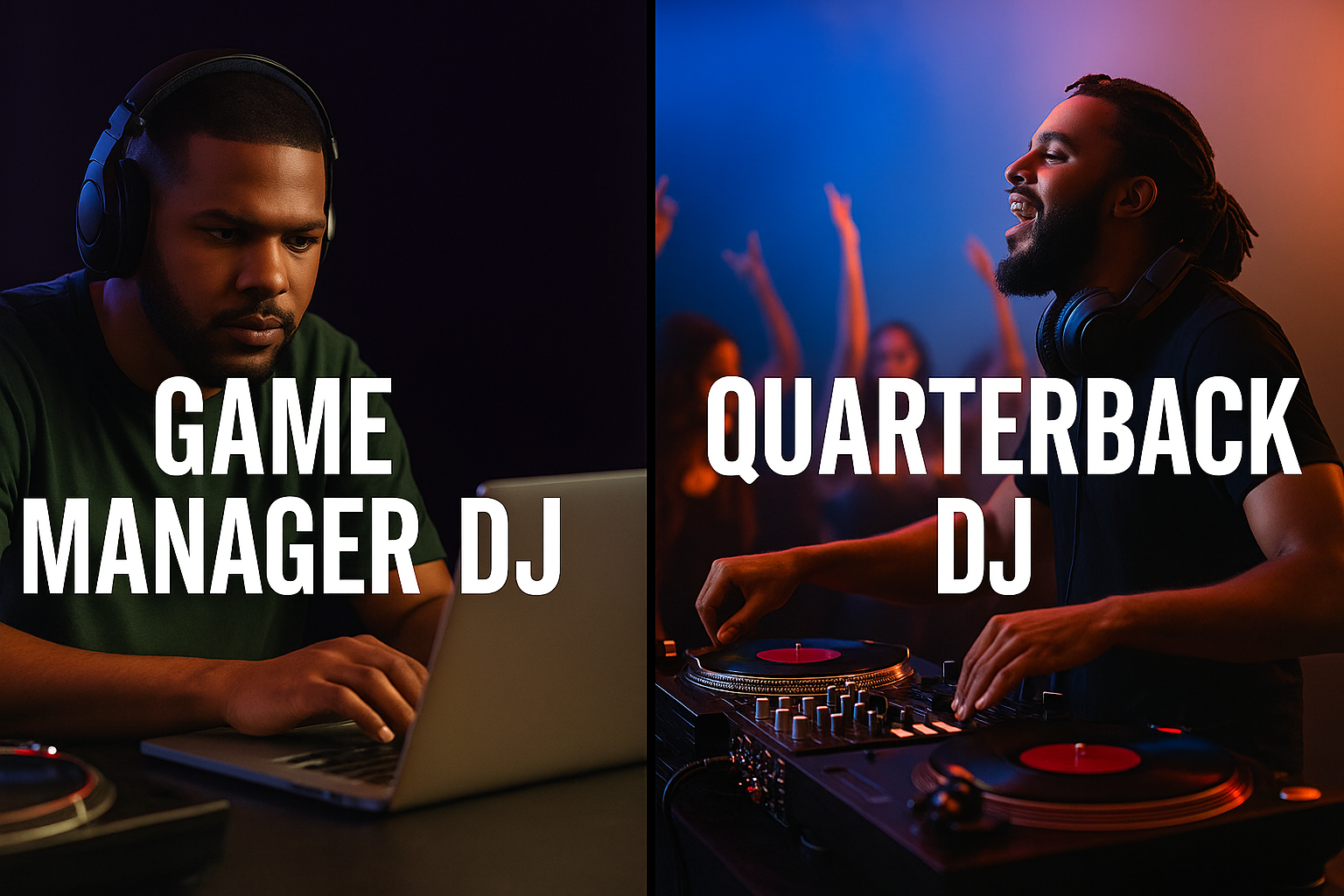
There are moments in your career when something you have seen a thousand times suddenly hits you with a fresh wave of truth. I experienced that at an event recently. Music was flowing from the booth, people were moving, conversations were overlapping, and every now and then someone would lift their head to see what the DJ was going to do next. As I stood there observing the energy in the room, something clicked in a way that it never had before. DJing is a lot like football. The more I watched, the more I realized the similarities are not small or symbolic. They are foundational.
Game Managers vs Real Quarterbacks
In football, there are two types of quarterbacks. The first type is the game manager. He is not there to create magic or shift momentum. He follows the script, sticks to short passes, does not try to push the ball down the field, and avoids anything that requires a deeper level of skill. His job is simply to keep the game safe and predictable. He does not take chances because he does not have the skillset to extend plays. He does not create new opportunities because he does not know how. He is on the field, but he is not leading the field.
The second type of quarterback is the one who truly embodies the position. This quarterback has vision. He understands timing. He sees the rhythm of the game and moves with it. He reads the field with intelligence and instinct. He knows when to stay calm and when to hit the gas. He understands when a deep throw will change the energy of the entire stadium and when a simple, quiet play is all the team needs. He feels the moment in a way that cannot be replicated through shortcuts. A real quarterback does not survive the game. He conducts it.
How This Applies to DJing
The DJ world mirrors these exact categories. There are DJs who manage events and DJs who create experiences.
The game manager DJs are the ones who simply play songs. They bounce from one BPM to another without understanding how that affects the energy of the room. They either let tracks play too long or cut them off too soon. They stare at their laptop more than they look at the crowd. They are constantly searching for the next track instead of guiding the moment they are in. They do not mix with purpose or awareness. They are not reading the floor. They are reacting instead of directing. They are game managers, which means the event is running them more than they are running the event.
The real DJs, the ones who function like true quarterbacks, operate on a completely different level. They know how long a record should breathe before moving on. They know when a transition will lift the room and when a quiet blend is the smarter move. They feel when the energy needs to rise and when it needs to settle. They know when to pull people back to the dance floor and when to give the room a moment to catch its breath. They understand structure, timing, and emotional flow. They rotate the floor with intention because they are paying attention to the room. They can see the changes in the crowd before those changes are obvious. They move with skill because they put in the work to understand the craft. They are conducting an experience from start to finish.
The Wild West of DJing
Here is where the problem begins. We live in a DJ world with no standards and no unity. Anyone can go buy a controller, download a playlist, and declare themselves a DJ. There is no structure. There is no baseline. There is no agreed-upon expectation for professionalism. Because of that, people offer services that they cannot deliver. In any other profession that would not be tolerated.
If an electrician claims skills they do not have, they can be sued. If a plumber takes on a job they cannot complete, they can be held accountable. If a contractor misrepresents their abilities, they can face legal consequences. But in the DJ industry, someone can completely botch an event and the conversation becomes emotional rather than professional. People say things like everyone makes mistakes, or they were just trying, or give them a chance.
Trying should happen at home. Trying should happen in practice. Trying should not be paid for by a client who trusted you with one of the most important days or events of their life. When someone pays you, it is no longer practice. It is a professional service.
The Problem of Defending Underperformance
One of the most damaging issues in our industry is how often people defend underperformance. They defend DJs who are not prepared. They defend DJs who do not practice. They defend DJs who have not invested in their craft. They defend DJs who cannot hold a dance floor. They defend DJs who do not understand mixing, phrasing, timing, or BPM flow.
And the question becomes why. Why protect mediocrity. Why protect habits that damage the reputation of all DJs. Why protect behavior that lowers the bar for everyone. The uncomfortable truth is that people often defend what they themselves relate to. When someone defends a DJ who clearly did not deliver, it is often because they operate at the same level. Real DJs do not defend careless work because they know what it does to the industry. Real DJs know that poor standards harm clients, harm prices, and harm the value of the craft.
The Pricing Collapse Caused by Lack of Structure
Pricing in the DJ industry is one of the clearest examples of what happens when there is no unity and no standards. In football, when one quarterback signs a major contract, the next quarterback typically signs a larger one. The standard rises. The industry grows. But in DJing, when one DJ charges a fair and professional price, another DJ comes in and drastically undercuts that price, not because their service is more efficient, not because they have a different business model, and not because they are creating a new tier of offering. They undercut simply because they want the gig, even when they are not prepared to deliver it.
This behavior lowers the value of the industry as a whole. It teaches clients that DJ services are cheap or negotiable. It teaches people that preparation and professionalism are optional. It teaches the market that DJs are interchangeable, when in reality the skillset of a real DJ is far from interchangeable. Skilled, experienced, intentional DJs lose income because unprepared DJs flood the market with low prices and low skill. No other industry allows that kind of damage without consequence.
Why Unity Matters
Every respected profession has unity at some level. Football players have unions. Electricians have standards. Hairstylists have licensing and training requirements. Musicians have organizations that protect the integrity of their work. DJs have talent, but we do not have unity. Without unity, we have no standards. Without standards, we have no accountability. Without accountability, the craft loses its shape.
DJing is not just playing music. It is leadership. It is emotional intelligence. It is the ability to read a room and guide energy. It is timing. It is preparation. It is understanding how people respond to music in real time. It is orchestrating experiences that people may remember for the rest of their lives. We owe the craft a level of respect that matches the responsibility of the role.
The Path Forward
There is absolutely a way forward. We can begin establishing a unified mindset even without forming a formal union. We can create shared expectations of professionalism. We can teach upcoming DJs the right techniques instead of letting them figure it out in front of paying clients. We can hold each other accountable in a respectful way that builds the industry instead of tearing it down. We can respect the craft enough to stop ignoring poor habits. We can openly share information that strengthens the culture.
Final Thoughts
DJing is a gift, but it is also a responsibility. People trust us with the energy of their event. They trust us with their celebrations and their memories. They trust us to guide the atmosphere. We owe them excellence. We owe the craft preparation and effort. We owe each other honesty and leadership.
Anyone can play music. But not everyone can quarterback a room. Real DJs understand the difference. And until we stand together with standards, unity, and intention, we will continue to fight the same battles. But if we ever decide to unite, to lead, and to protect the integrity of this craft, the entire industry will rise.